
There may be occasional breaks in the service. We apologise for any inconvenience.
Requesting a payment arrangement – individual taxpayers
When the Tax Administration sets up a payment arrangement for you, you will have more time to pay your tax debt and you can divide the total into smaller instalments. If you follow the terms and conditions, the Tax Administration will not send any taxes covered by the arrangement to the Enforcement Authority for enforced recovery.
The instructions on these pages are for individual taxpayers not liable for paying self-assessed taxes nor value-added tax based on VAT registration.
Instructions for requesting a payment arrangement for business taxpayers
Before you request a payment arrangement
You do not always need a payment arrangement if you want to pay a certain tax in instalments or if you need more time to pay it. Instead, you can do this:
1. Pay instalments of your choice before the due date
Every individual taxpayer is entitled, on their initiative, to divide a tax into two or more instalments for payment, to make it easier to pay the tax. There is no need to request a payment arrangement for doing that. Pay the instalments in either your e-bank or in MyTax. When using the e-bank, you need to type in the bank reference number for the correct type of tax every time.
If part of the tax is still unpaid on the due date, you can request a payment arrangement for the final payment.
2. Pay only after you receive a payment reminder
If you just need approximately one extra month for paying the tax, you can delay your payment a little: pay the tax only after you receive the reminder. You do not need to request a payment arrangement. However, when you choose to pay a tax that way, you must pay late-payment interest. The period when the interest is collected will begin the day after the original due date – and go on up to the day when you pay the tax.
You will receive 1–3 reminders before the Tax Administration sends the unpaid tax to the Enforcement Authority for recovery. The number of times you get a reminder depends on whether you have other taxes that are unpaid. Please note: when you haven’t paid a tax, the payment reminder that you receive from the Tax Administration will not be a distinct letter. Instead, the reminder will take the form of a text inserted into your Summary of tax payment status. Read more about the summary.
Example starts
Example: Harry’s due date for back taxes is 3 August 2026. He decides not to pay the back tax by due date, letting time pass until the Tax Administration sends him a reminder. As a result, the reminder message appears in MyTax at the beginning of September. It indicates 22 September 2026 as the due date of the now overdue back tax.
Harry uses MyTax to pay it by that date. A late-payment interest, accrued between 4 August and 22 September 2026 is automatically added to the amount in MyTax.
Example ends
When can I submit a request for a payment arrangement?
If you meet all the conditions below, you can submit the request:
- Your financial difficulties are temporary, not long-term.
- If you ever were on a payment plan before, you paid up all the instalments successfully.
- You have submitted all tax returns as required.
- No unpaid tax of yours is undergoing enforcement proceedings, and the Enforcement Authority has not declared that you’d be “without means”.
- You are not undergoing a debt-adjustment process that would involve taxes left unpaid.
The arrangement will automatically include the taxes that are overdue, and additionally, the taxes falling due in the forthcoming 45 days. When appropriate, the Tax Administration will set up a payment plan with a higher first instalment as a precondition, so your payment arrangement can be approved.
Payment plans are made for a maximum duration of 2 years, and the lowest possible instalment is €20. If the payment plan covers any taxes about to expire soon, the duration can be shorter than 2 years.
According to the statute of limitations, the expiration of a tax takes place 5 years after the start of the year following the year when the tax was imposed, collected or fallen due. For example, when the due date of a back tax is 1 August 2025, it will expire on 31 December 2030.
An exception to this is an inheritance tax with a due date for the first instalment 1 January 2024 or a later date. These inheritance taxes have an expiration period extending to 12 years, from the beginning of the year after the year when the inheritance tax was imposed.
In general, payment arrangements always end no later than 6 months before the date of expiration of the taxes concerned.
How to request a payment arrangement
Submit your request for a payment arrangement in MyTax. Make sure that the payment schedule and payment instalments you have planned are suitable for you before you send your request.
Once the Tax Administration has accepted the request, you can no longer change the planned schedule or instalments. There can only be one payment arrangement in force.
-
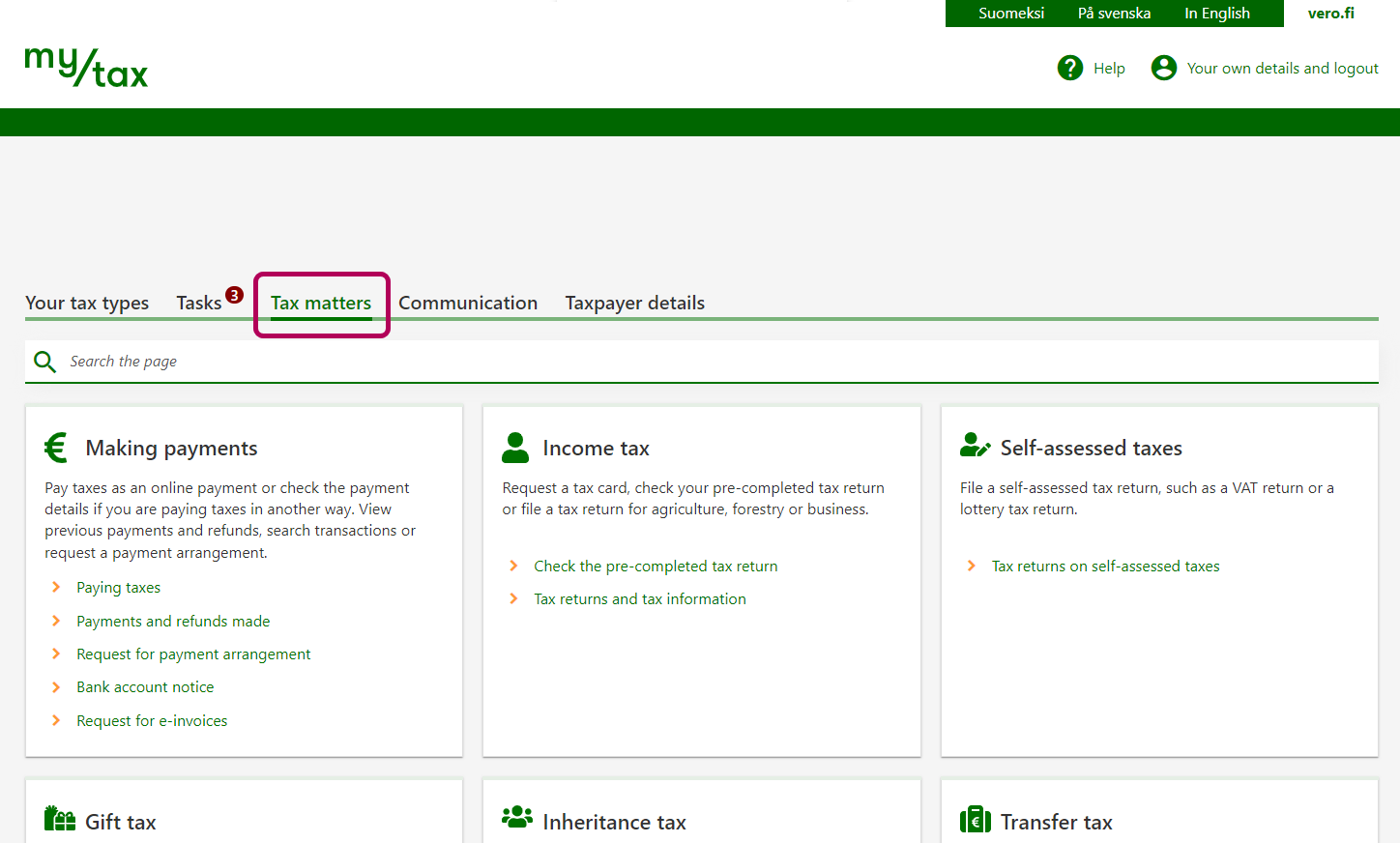
Select the Tax matters tab on the MyTax home page.
-
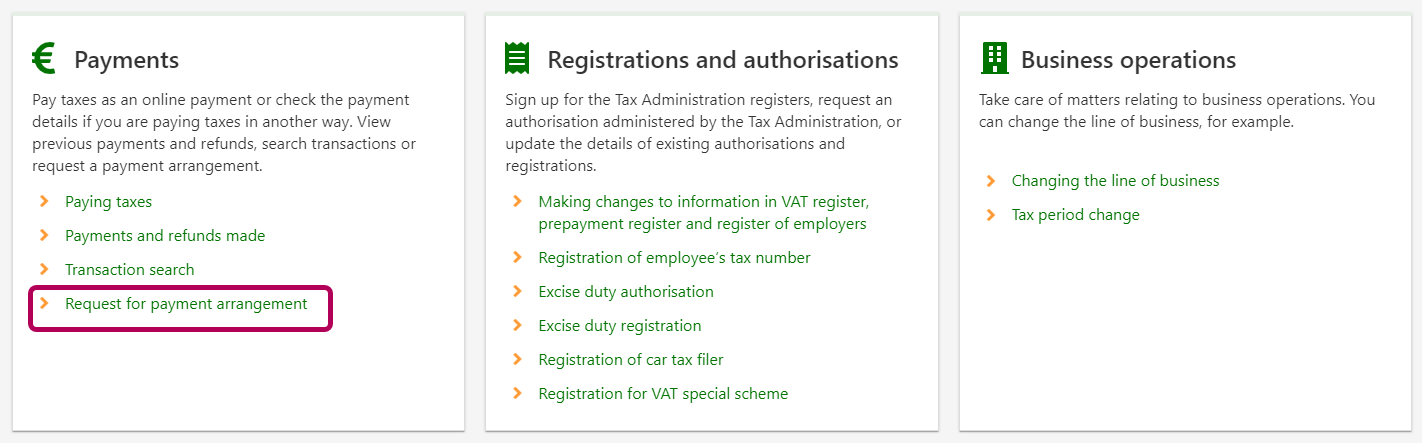
Click the link Request for payment arrangement in the Making payments section.
-
The MyTax request has 3 stages.
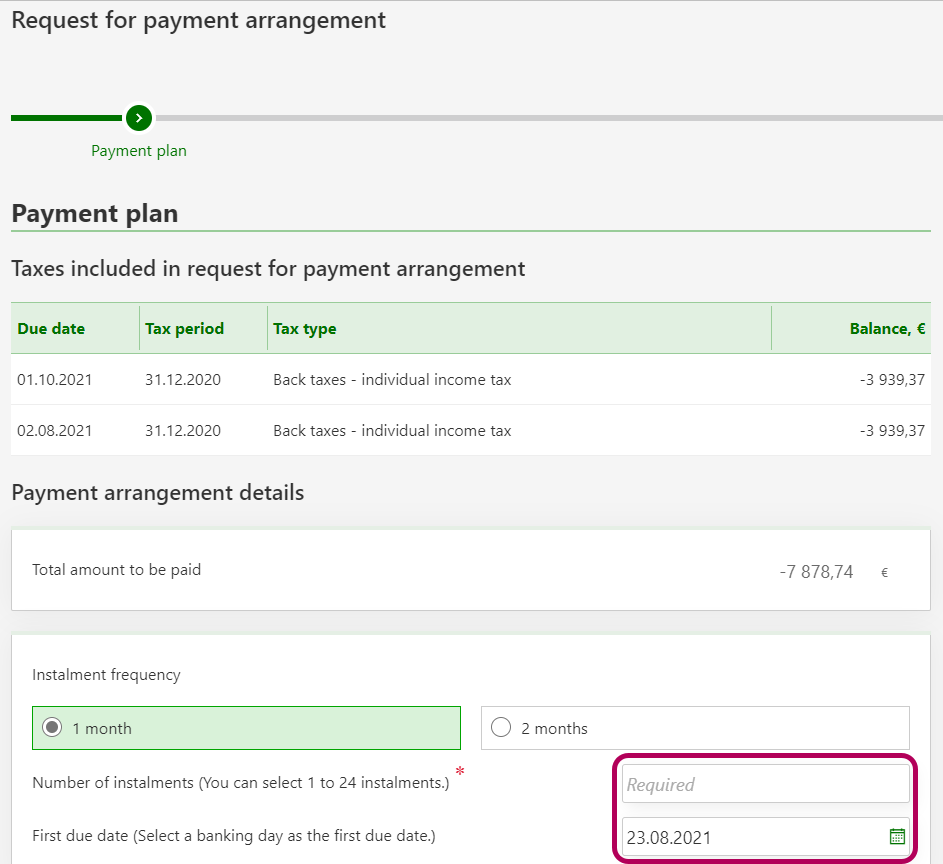
The Payment plan stage: You can see the taxes and the details of the payment arrangement request.
- You should determine how many instalments you want to have.
- Select the due date for the first instalment.
There can be between 1 and 24 instalments. The interval between them is 1 month. If you only have to pay back taxes – as an individual taxpayer – or prepayments, an inheritance tax, gift tax or real estate tax, you can select a 2-month interval. The maximum number of instalments is 12 for the 2-month intervals. The first due date must not be more than 30 days later than the date when you submitted your request for the arrangement.
-
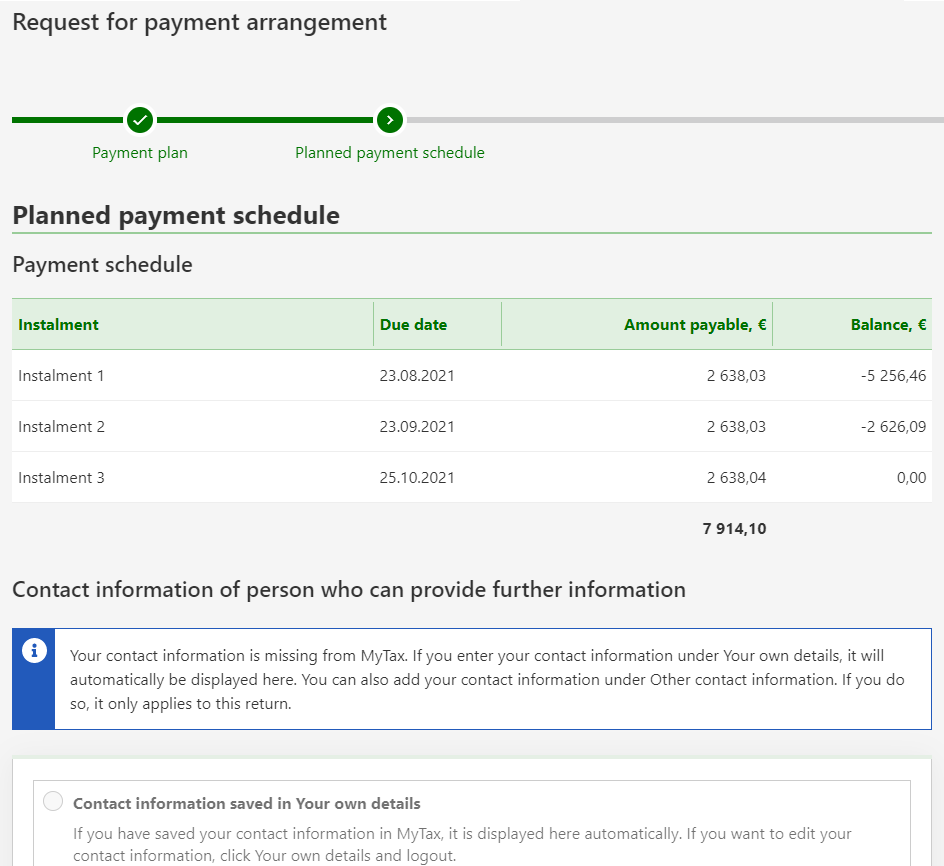
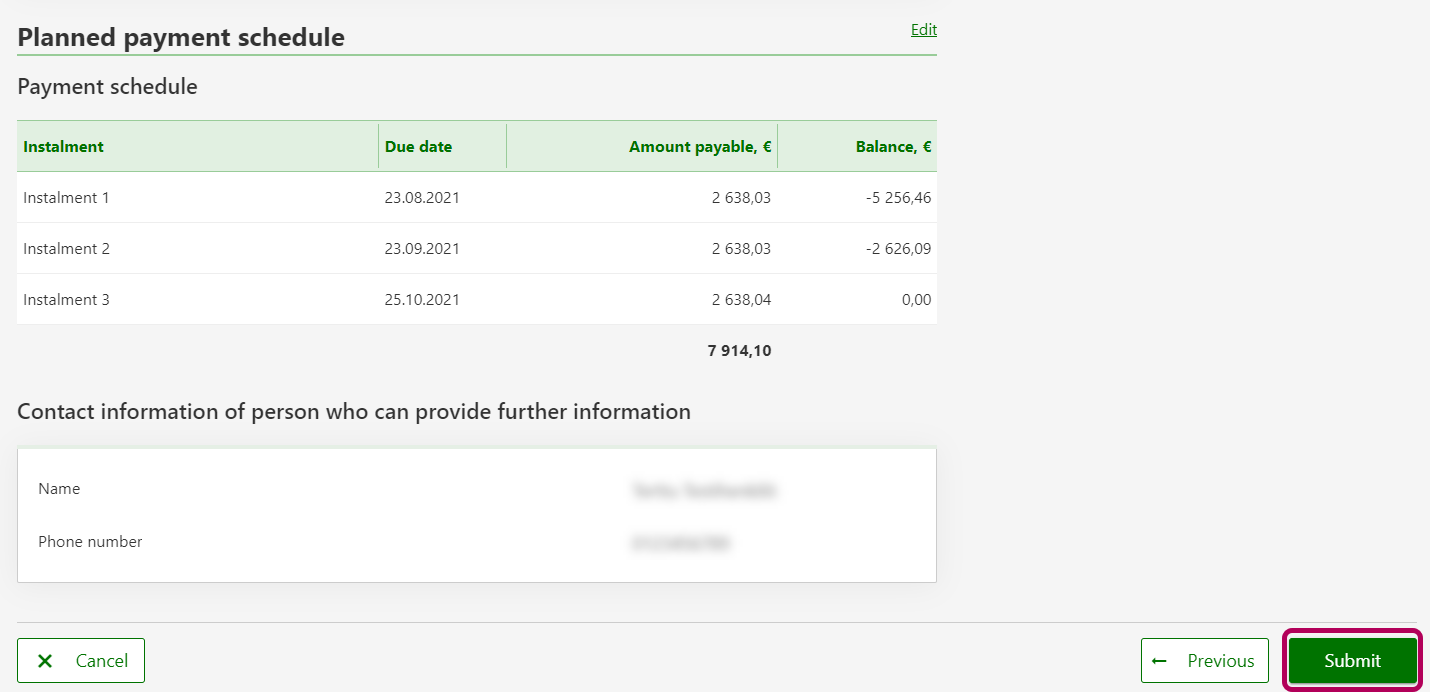
The Planned payment schedule stage: You can see the payment plan’s amounts and due dates.
For the person to contact – if the Tax Administration needs further information – MyTax will automatically show your name if your contact details are in the Tax Administration’s records. If no person to contact is shown, you should add your personal details. If someone else provides further information, write that person’s details into the appropriate fields.
-
Stage Preview and send: Please double-check the entries and details. Finally, click Submit.
If you cannot use MyTax, you can request a payment arrangement by calling our service number on 029 497 028 (standard call rates).
Further instructions if you request a payment arrangement for any of the following taxes
It is advisable to request a payment arrangement for back taxes only after the first due date. After that, the Tax Administration will send you a reminder message with a due date on it. You should submit a request only if you are sure that by the due date stated on the reminder, you will still be unable to pay your back tax.
You can request a payment arrangement for a car tax. However, it is important to note that you must pay all the car tax included in the payment plan before you can have the vehicle registered. Only a registered filer of car tax can register a vehicle before the car tax is paid in full.
You can request a payment arrangement for inheritance taxes. If you request a payment arrangement for some other type of tax, an unpaid inheritance tax will automatically be added to the arrangement.
How much time you have to pay the tax and when the unpaid tax will be transferred to enforced recovery proceedings depends on the due date of the inheritance taxes’ first instalment. Choose the instructions below that apply to you, based on the due date:
The due date of the first instalment was 1 January 2024 or later
The Tax Administration will not transfer your inheritance tax to enforced recovery until 10 years after the due date of the first instalment. During that time, you can make payments toward the inheritance tax without a payment arrangement.
If you request a payment arrangement for the inheritance tax, you will have to pay the full amount within 2 years.
In both options, collection of late-payment interest will begin the day after the due date up to the day when you pay the full amount. In addition, any tax refunds you receive will also be used to cover your inheritance tax until you pay the full amount.
The due date of the first instalment was before 1 January 2024
If it remains unpaid, the inheritance tax will be transferred to enforced recovery 2 years after the first instalment’s due date. However, you can make payments toward the inheritance tax without a payment arrangement before the 2-year period is over.
If you request a payment arrangement for the inheritance tax, you will have to pay the full amount within 2 years.
In both options, collection of late-payment interest will begin the day after the due date up to the day when you pay the full amount. In addition, any tax refunds you receive will also be used to cover your inheritance tax until you pay the full amount.
Expiration of an inheritance tax
According to the statute of limitations, the expiration of tax debts takes place 5 years after the start of the year following the year when the tax was imposed, collected or fallen due.
An exception to the above rule is an inheritance tax with a due date for the first instalment 1 January 2024 or a later date. These inheritance taxes have a longer expiration period, extending to 12 years from the beginning of the year after the year when the inheritance tax was imposed.
In the following circumstances, you can request a payment arrangement only for the first instalment of the tax
- You had received the tax relief, which reduces inheritance or gift taxes because assets and property are being transferred to the next generation.
- The inheritance tax/gift tax, with the relief, had been divided into max. 10 instalments to be paid once a year.
You can request a payment arrangement on an estate’s behalf if you are a shareholder of the estate having a letter of authorisation, signed by all the shareholders of the estate. Alternatively, someone outside the estate can request a payment arrangement as well if a letter of authorisation signed by all the shareholders of the estate is issued.
A transfer tax can be included in the payment arrangement you are requesting. Note, however, the following:
- You cannot receive title for a house or other real-estate property until you have paid the entire transfer tax. If you apply for title registration after the standard 6-month deadline, you must pay a late-filing penalty charge.
- You cannot get your ownership of an apartment registered until you have paid the entire transfer tax. Your name can only be entered into the housing-company’s list of shareholders and shares when the National Land Survey has been informed of the payment.
However, when a payment arrangement is in force and it covers your unpaid transfer tax – besides other taxes – you can pay that transfer tax faster than planned within the arrangement’s normal schedule. When you pay the transfer tax this way, type in the special reference number of transfer taxes. When you have sent your payment, the Tax Administration will apply it to the transfer tax included in the arrangement, if you do not have, outside of the payment arrangement, another transfer tax that you would need to pay.
When will my payment arrangement come into force?
When your request has arrived, the Tax Administration will process it in approximately one week. The arrangement enters into force as soon as the Tax Administration has accepted your request.
It is possible that you receive a phone call from a Tax Administration official to discuss the matter with you.
The Tax Administration may use automated decision-making when processing the request. This may mean that your request for a payment arrangement will be approved in an automatic process, to enter into force immediately on the day following the request. Read more about the Tax Administration’s automated decision-making (available in Finnish and Swedish, link to Finnish).
Yes, a request may be turned down if the Tax Administration were to find that the requirements for a payment arrangement remain unfulfilled or if an arrangement would not be feasible when all the relevant circumstances are evaluated.
In general, payment arrangements are to be used in temporary financial difficulties. After you have had a payment arrangement previously – even if you paid all the instalments – the Tax Administration may turn down a new request for a payment arrangement if your tax debt has increased compared to the previous payment arrangement.
If the Tax Administration turns down your request, you will receive a letter explaining the reason.
Compliance with the terms and conditions of the arrangement
When the Tax Administration has accepted your request, you will receive your payment plan and a set of instructions. Your payment arrangement will remain in force when you comply with its terms and conditions:
- Adhere to the timetable – in other words, pay the instalments on time.
- Pay all your other taxes – those not included in the arrangement.
- If due dates for submitting any tax return are approaching, make sure to send the tax return on time.
Your payment arrangement may cease to be in force if you cannot live up to the terms and conditions.
Read more about a cancelled arrangement and the way to request a new one
Your MyTax inbox will contain the plan schedule and instructions:
- Go to MyTax if you are not logged in (will open in a new tab).
- Select the Communication tab.
- Under Decisions and letters, select Open decisions and letters.
All the decisions and letters you have received during the past 12 months will be listed. To find decisions and letters over 12 months old or that have been opened or archived, use Search.
How to pay the taxes that are covered
You can pay the instalments in your e-bank or in MyTax. You cannot pay the instalments of a payment arrangement with e-invoices.
Pay the instalments according to schedule, in equal-size instalments. Your payment plan’s first due date will be set at a date little less than a month after the date when the Tax Administration accepts your arrangement. When you pay an instalment, you need to type in the payment arrangement reference number.
If you pay taxes other than those covered by the arrangement, you will always need to enter the bank reference number for that tax into the payment information when you send the payment in your e-bank/MyTax. This way, the entries in the Tax Administration’s records will be right.
Please re-check that your payment arrangement actually covers this particular tax. To make that check, please re-read the instructions that you received at the start.
If the tax is covered, you can log in to your e-bank and delete the e-invoice. The tax will be paid as you pay the instalments. When paying, type in the payment arrangement reference number.
Yes, you can. You are free to choose to pay taxes on a faster schedule or to increase the size of any instalment. Remember to type in the reference number for your payment arrangement every time you pay.
Make sure that nothing is missed as scheduled items. Your payment arrangement may cease to be in force if you miss payments or if you pay too little.
In the reverse case, if you pay the instalments faster or increase instalment size(s), the amount of late-payment interest will decrease. This way, your payment arrangement may end earlier than planned.
Example starts
Example 1: Jennifer is an individual taxpayer. A payment arrangement that lasts for 12 months has been agreed, with January as the start month. The monthly instalment is €100.
However, Jennifer decides to pay €300 on the due date of January. After that, she proceeds to pay her instalments every month according to schedule. This way, her payment arrangement will end in September, not December. The period for late-payment interest would also terminate in September, so Jennifer will pay less interest.
Example ends
Alternatively, when you are on a payment plan, you can pass an instalment or several instalments over. This is another way to match the value of an extra payment. After doing that, you need to resume your payments.
Example starts
Example 2: Jennifer is an individual taxpayer. A payment arrangement that lasts for 12 months has been agreed, with January as the start month. The monthly instalment is €100.
However, Jennifer decides to pay €300 on the due date of January. The Tax Administration will use the extra money on the payment plan’s instalments for January, February and March. In April, Jennifer resumes paying the planned 100-euro instalments.
The payment arrangement will end in December in accordance with the planned schedule when she pays the final instalment.
Example ends
A payment arrangement does not change the late-payment interest
The fact that a payment arrangement is agreed upon has no impact on the amounts of late-payment interest. In other words, all the taxes that are covered are subject to late-payment interest, which you must pay.
The period for interest calculation begins the day after the original due date of the tax(es), ending on the day when you have paid all the taxes covered by the arrangement.
In 2026, the rates of late-payment interest are as follows: 4.5% for an inheritance tax paid late, and 9.5% for all other types of taxes paid late.
If taxes should be refunded to you when you are on a payment plan
In a situation where you would be getting a tax refund at a time when a payment arrangement is in force, the Tax Administration will refrain from paying it. Instead, the Tax Administration uses the money towards settling your payment arrangement partially.
As a consequence, the arrangement may end earlier than planned. This requires that you pay all the instalments according to plan. Alternatively, you may match the amount of your refund against your instalments, in other words, you pay less by subtracting the refundable amount from one or several instalments. After that, you should resume paying the instalments.
Key terms: